
Palmistry: meaning and symbolic language
The Italian word for palmistry, chiromanzia, joins the Greek words for hand and divination; in English it is also called chiromancy. The practice interprets the shape of the palm, the fingers, the lines and the mounts of the hand through symbolic correspondences handed down by different schools.
Reading a hand requires looking at the whole. The position of a line, its course and its relationship with the other signs all contribute to the interpretation. For beginners, the most useful approach is to learn to recognise a few clear traces and gradually widen the observation.
Which hand do you read: right or left?
The question “which hand do you read?” is one of the first steps of the practice. Schools of palmistry use different criteria; a common approach compares the dominant hand with the non-dominant one.
The dominant hand, the one you normally write with, is associated with how your inclinations are expressed in daily life. The non-dominant hand is linked to your predispositions and starting potential.
If you write with your right hand, you can start from that palm and compare it with the left. If you are left-handed, you can start from the left. The distinction should be understood as an interpretive convention: looking at both hands lets you spot similarities and differences without relying on a single rule.
How to read your palm: the first steps
Sit somewhere well lit and rest your hand in a comfortable position. Open your fingers naturally and keep your palm relaxed.
Follow this order:
- Look at the overall shape of the palm and the proportions of the fingers.
- Find the life line, the head line and the heart line.
- Look for the fate line, if it is visible.
- Note the direction, continuity and branches of the lines.
- Compare the same points on the other hand.
Describe what you see before giving it a meaning. “A curved, clearly visible line” is an observation; “great emotional openness” is an interpretation. Keeping these two levels in mind helps you build a more careful reading.
The lines of the hand and their meanings
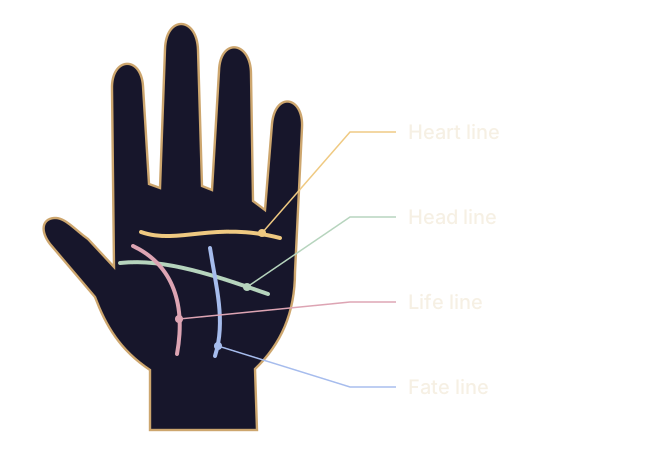
The three easiest lines to recognise are the life line, the head line and the heart line. The fate line often runs vertically and can be less visible.
| Line | Where to find it | Symbolic theme |
|---|---|---|
| Life | Curves around the base of the thumb | Vitality and your relationship with experience |
| Head | Crosses the centre of the palm | Thought, imagination and decisions |
| Heart | Runs across the top, below the fingers | Feelings and emotional expression |
| Fate | Rises through the palm towards the middle finger | Vocation and personal direction |
Use this map as an initial guide. The meaning of the lines of the hand varies from school to school and is understood by comparing the different signs.
Life line: energy and grounding
The life line usually begins between the thumb and the index finger and draws an arc around the base of the thumb towards the wrist. It is one of the first lines to find when you learn how to read a palm.
In contemporary interpretations it is associated with vitality, grounding and the way you face experiences. Its length cannot be used to calculate how many years you will live.
Notice how visible it is, how the curve develops and whether the line has branches. Variations are sometimes read as symbols of transitions and changes of direction. A break calls for looking at the nearby signs and the other palm too.
Head line: the movement of thought
The head line crosses the central area of the hand. It may start close to the life line or be joined to it for a short stretch.
Palmistry links it to the way you reason, imagine and make decisions. A straighter course is often associated with a practical outlook; a line sloping downwards is linked to imagination and intuition.
You can use these symbols to reflect on how you approach a choice: do you look for a clear structure first, imagine different possibilities or alternate between the two? The observation becomes more interesting when you relate it to examples from your own experience.
Heart line: the language of affection
The heart line lies in the upper part of the palm, below the fingers. It extends from the little finger towards the index or middle finger, with different shapes and endings.
In tradition it represents emotional life and the way you express your feelings. A pronounced curve is often associated with expressiveness, while a straighter line can suggest a more reserved attitude.
Look at the line without immediately passing judgement on your love life. You can ask yourself how easily you communicate a need, how you welcome closeness and what balance you look for between intimacy and personal space.
Fate line: vocation and direction
The fate line usually rises from the lower or central part of the palm towards the middle finger. It can be sharp, faint, broken or hard to recognise.
Its symbolism concerns your personal path, work and sense of vocation. Some schools interpret changes in the line as images of a direction being redefined.
Its absence is a normal possibility among the variety of hands and does not imply a lack of prospects. To explore its theme, ask yourself what gives continuity to your choices and which aspirations you want to nurture.
How to read the lines of the hand together
Once you have recognised the main lines, go back to looking at the whole palm. Pay attention to the points where lines come close, change direction or split.
For your first reading, choose one theme and gather a few observations. If you are interested in the relationship between thought and feelings, look at the head line and the heart line. Write a short description of both, then note the questions they raise.
This small exercise stops you from chasing every detail and makes the path clearer. You can repeat it later with another theme, gradually becoming more familiar with the symbols.
The mounts of the hand: the raised areas that complete the reading
The raised areas of the palm are called mounts. In tradition they carry planetary names: Venus at the base of the thumb, Jupiter below the index finger, Saturn below the middle finger, Apollo or the Sun below the ring finger and Mercury below the little finger.
To begin with, just learn to recognise where they are. You can notice how much each area stands out and how the lines cross the palm near it. Studying the mounts comes after you know the main lines well.
From observation to your first reading
Take a sheet of paper and divide your observation into three parts: what you see, the traditional meaning and the personal questions that come up. It is a simple way to separate the pattern of the hand from the reflection that grows around it.
Once you have recognised the main lines, you can compare your notes with a free palm reading. Use the prompts you receive to explore the symbols that intrigue you and develop your own eye.
Palmistry keeps the fascination of a close encounter with mystery. The palm provides the material to observe; your sensitivity gives shape to the questions.
Frequently asked questions about palm reading
How do you read a palm for the first time?
Start with the life line, the head line and the heart line. Learn to recognise where they are, describe their course and compare the two palms. Later you can add the fate line and the mounts.
Does a short life line mean a short life?
No. The length of this crease does not determine how long you will live. In contemporary symbolic reading its main theme is vitality and your relationship with experience.
In palmistry, do you read the right or the left hand?
The conventions vary from school to school. You can start from your dominant hand and compare it with the non-dominant one, looking at both.
What does a missing fate line mean?
This line can be faint or absent. You don’t need it to start a reading, and its absence does not determine personal success.
How long does it take to learn to read palms?
You can recognise the main lines from your very first observations. Understanding the language of the different schools takes practice, comparison and gradual study.